
SSL/TLS certificate and domain renewal monitoring
Catch the certificate renewal that didn't happen.
CertWatch connects to your servers every hour and reads the certificate they actually present. It learns when each certificate should renew and alerts only when that renewal doesn't reach the server.
No credit card required.
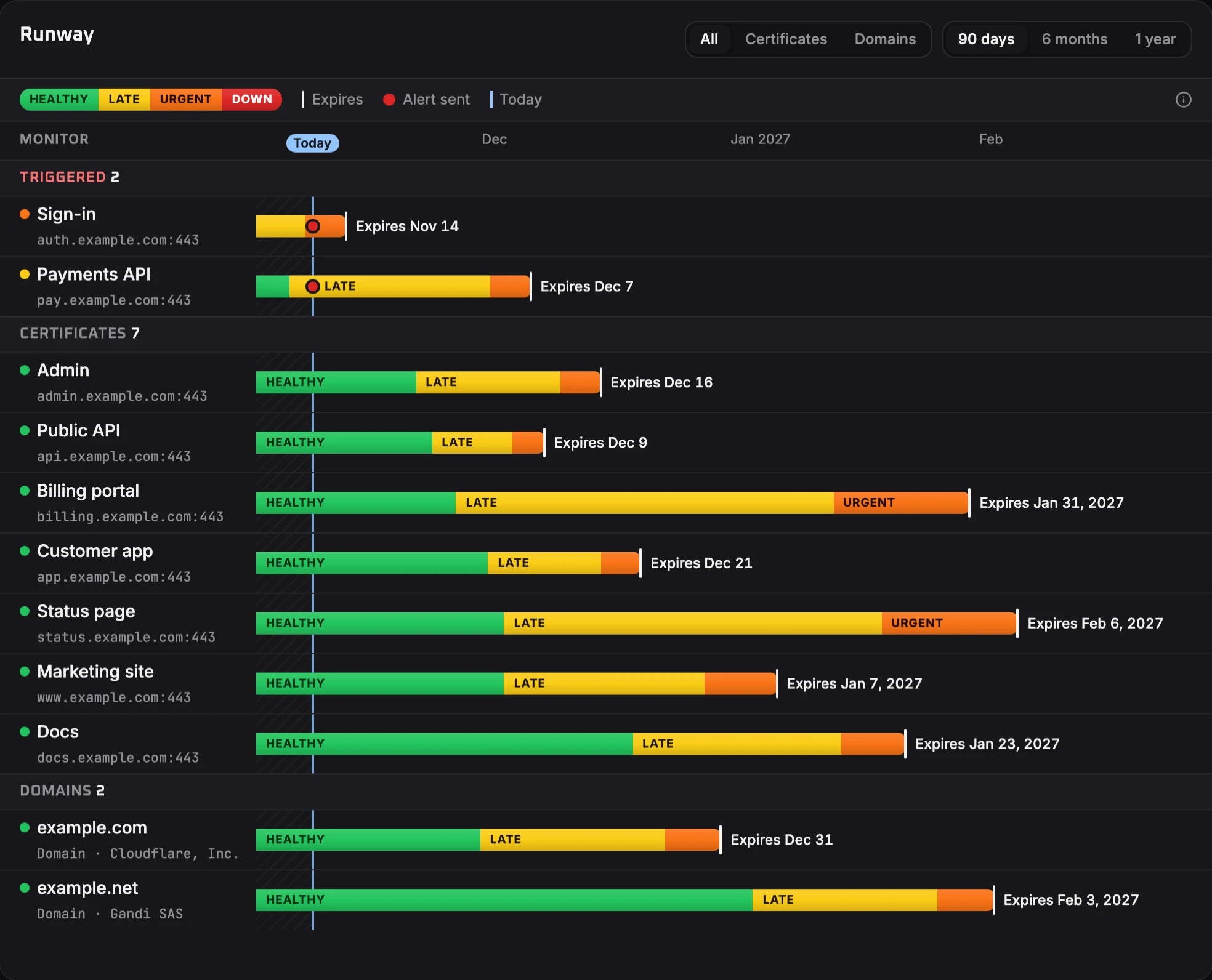
Certificate lifetimes are shrinking. Every renewal is one more chance for automation to fail.
The CA/Browser Forum is cutting the maximum certificate lifetime from 398 days to 47 by March 2029. A certificate that renewed once a year will renew about twelve times, and each of those renewals can fail or never reach the server.
A renewal can succeed and never reach the server.
A certbot, acme.sh or cert-manager renewal can succeed while a server keeps the old certificate. CertWatch opens a direct TLS connection to each host and port and reads the certificate clients actually get, on APIs, load balancers and mail servers as well as websites.
$ certbot renew
Congratulations, all renewals succeeded:
/etc/letsencrypt/live/api.example.com/fullchain.pem (success)- Issuer
- Let's Encrypt
- Renewal expected
- 5 days ago
- New certificate
- Not on the server yet
Every hour, from outside. Nothing to install.
Give CertWatch a hostname and port, or a domain name. It connects over the internet, the way a browser or API client does, so there is no agent to run on your servers.
- 01 · every hour
Starts on the hour.
Every endpoint, on every plan, Free included.
- 02 · up to 8 addresses
Reads every address.
A renewal deployed to only some backends shows.
- 03 · learned schedule
Checks the schedule.
Learned from the renewals it has watched, or set by you.
- 04 · alert or stay quiet
Alerts only if it's late.
A renewal that arrives on schedule sends nothing.
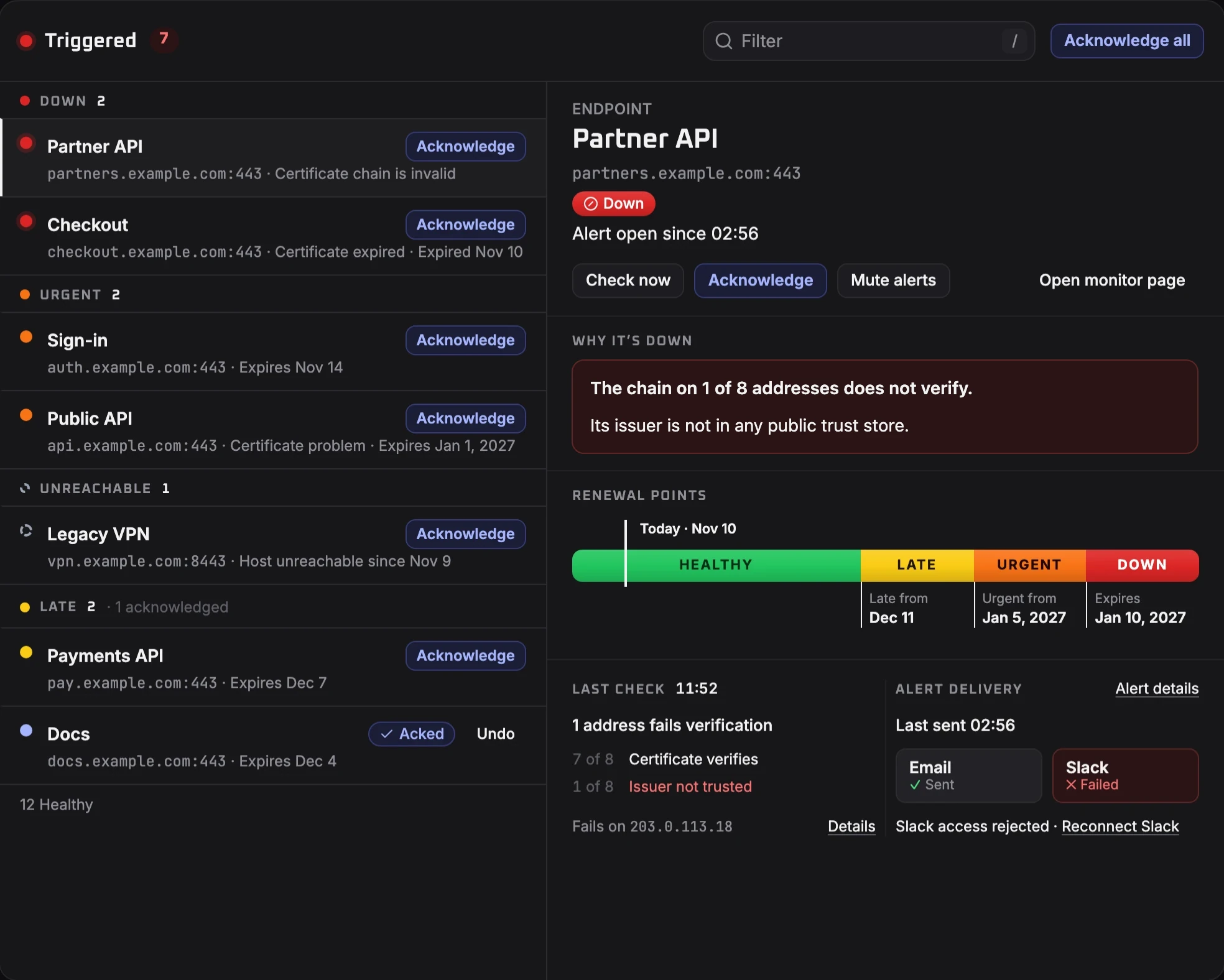
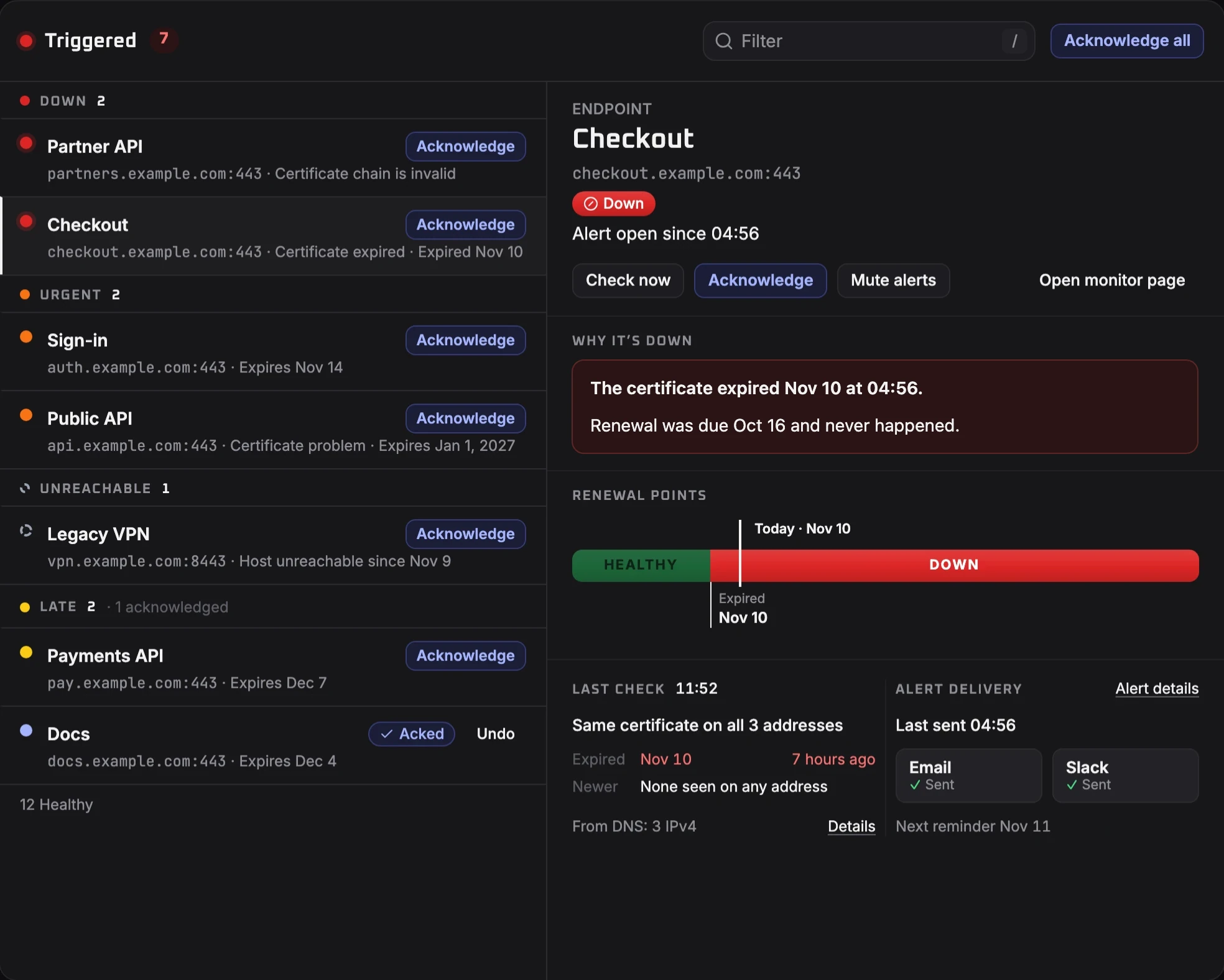
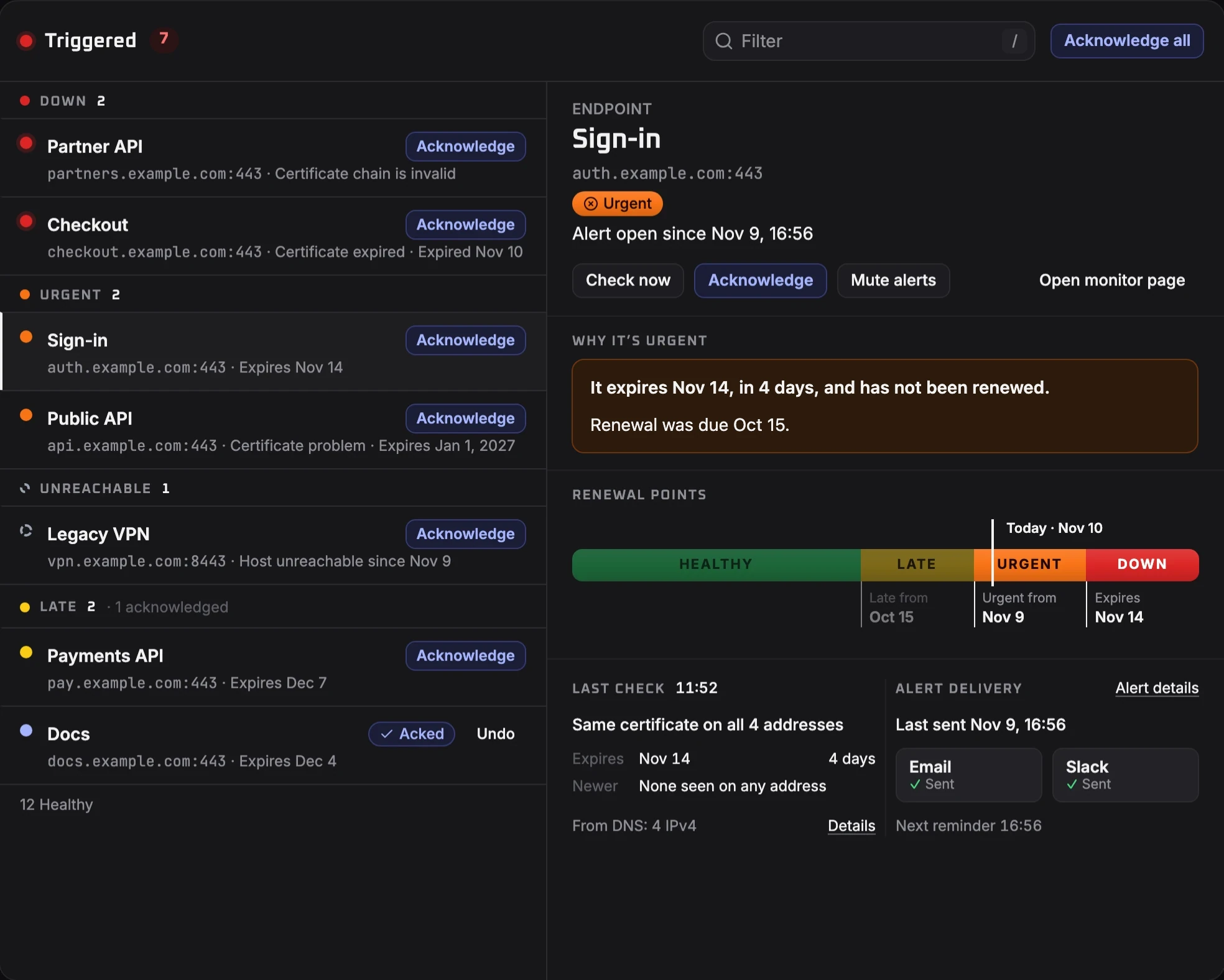
From alert to action. What failed, how long you have, who's been told.
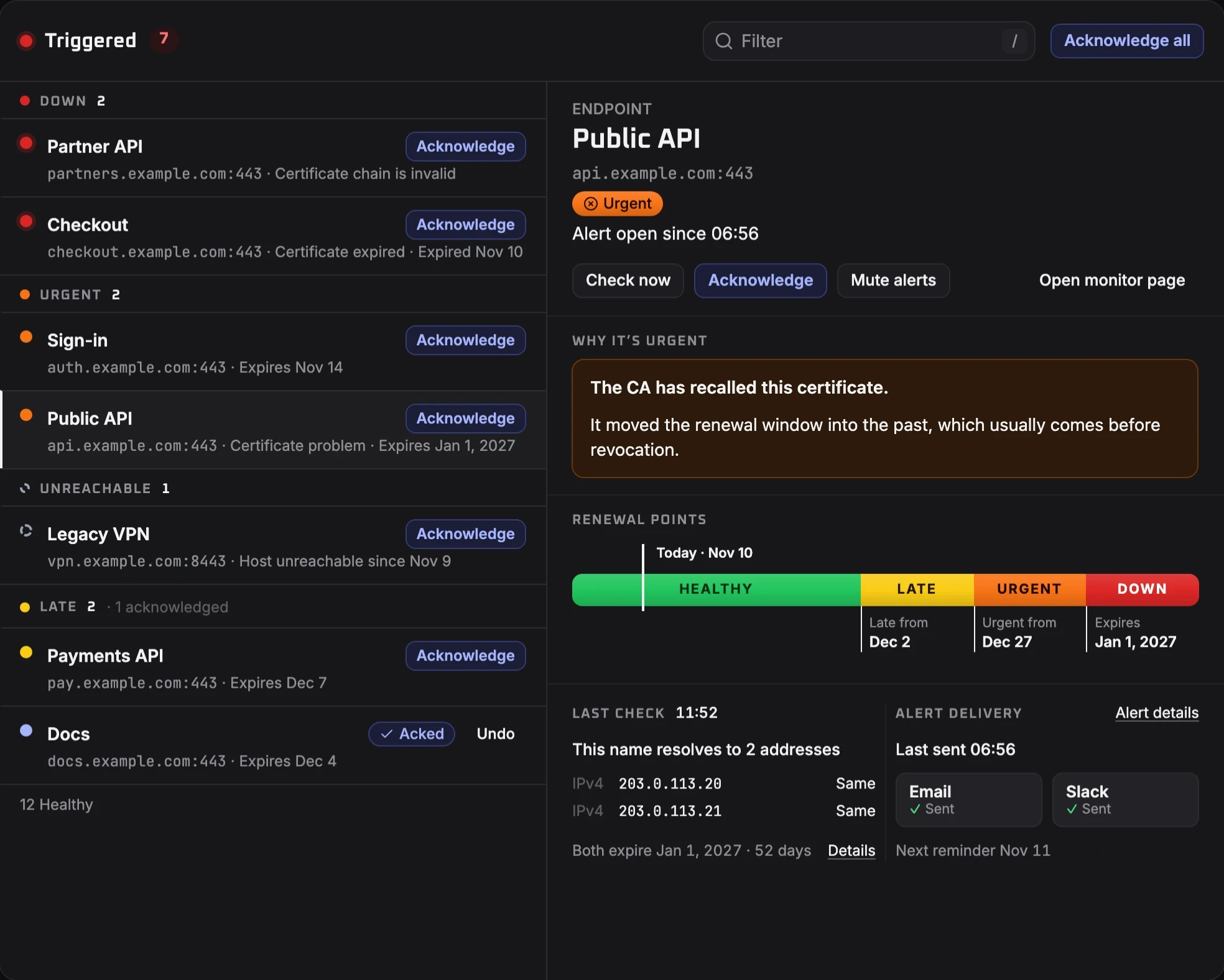
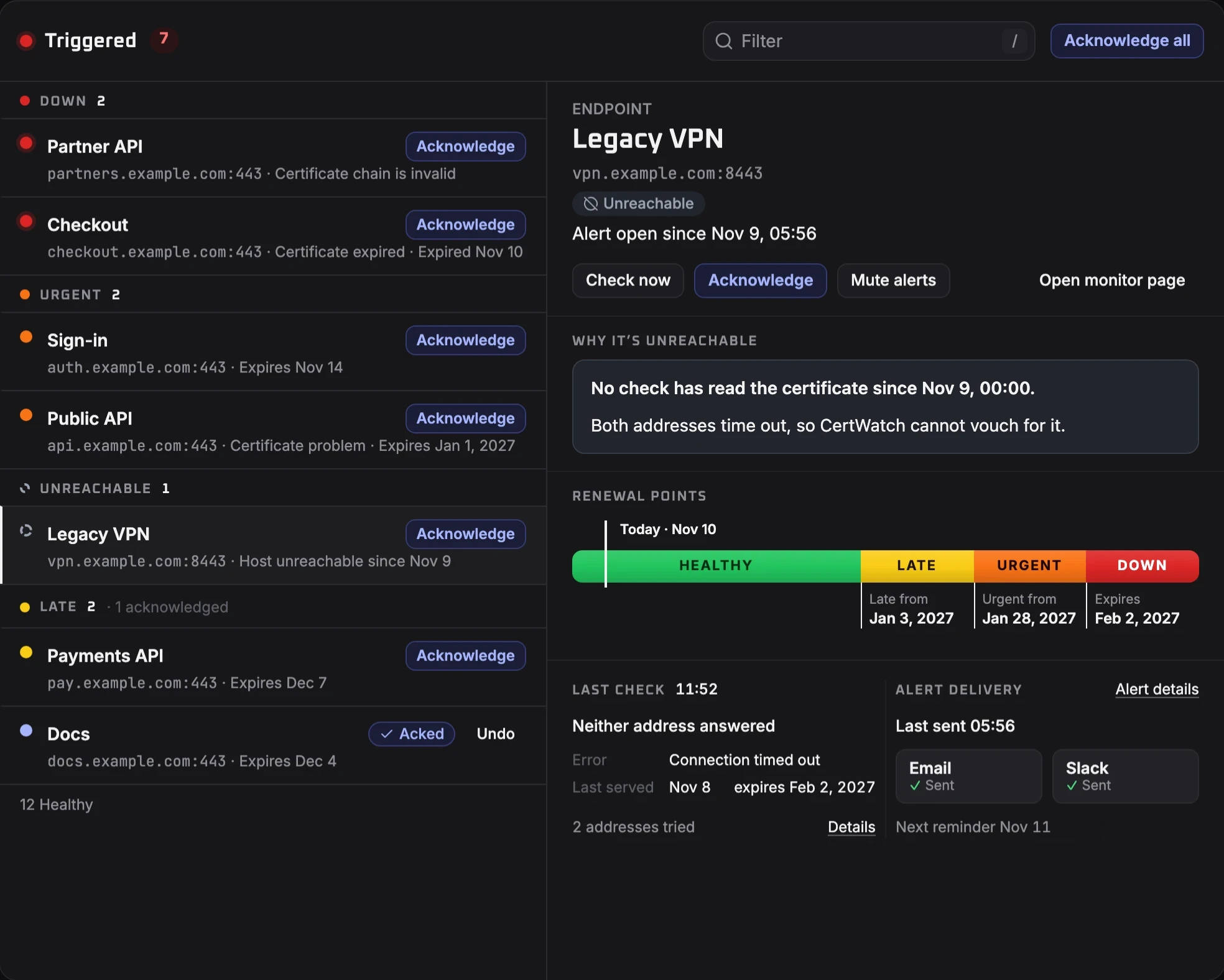
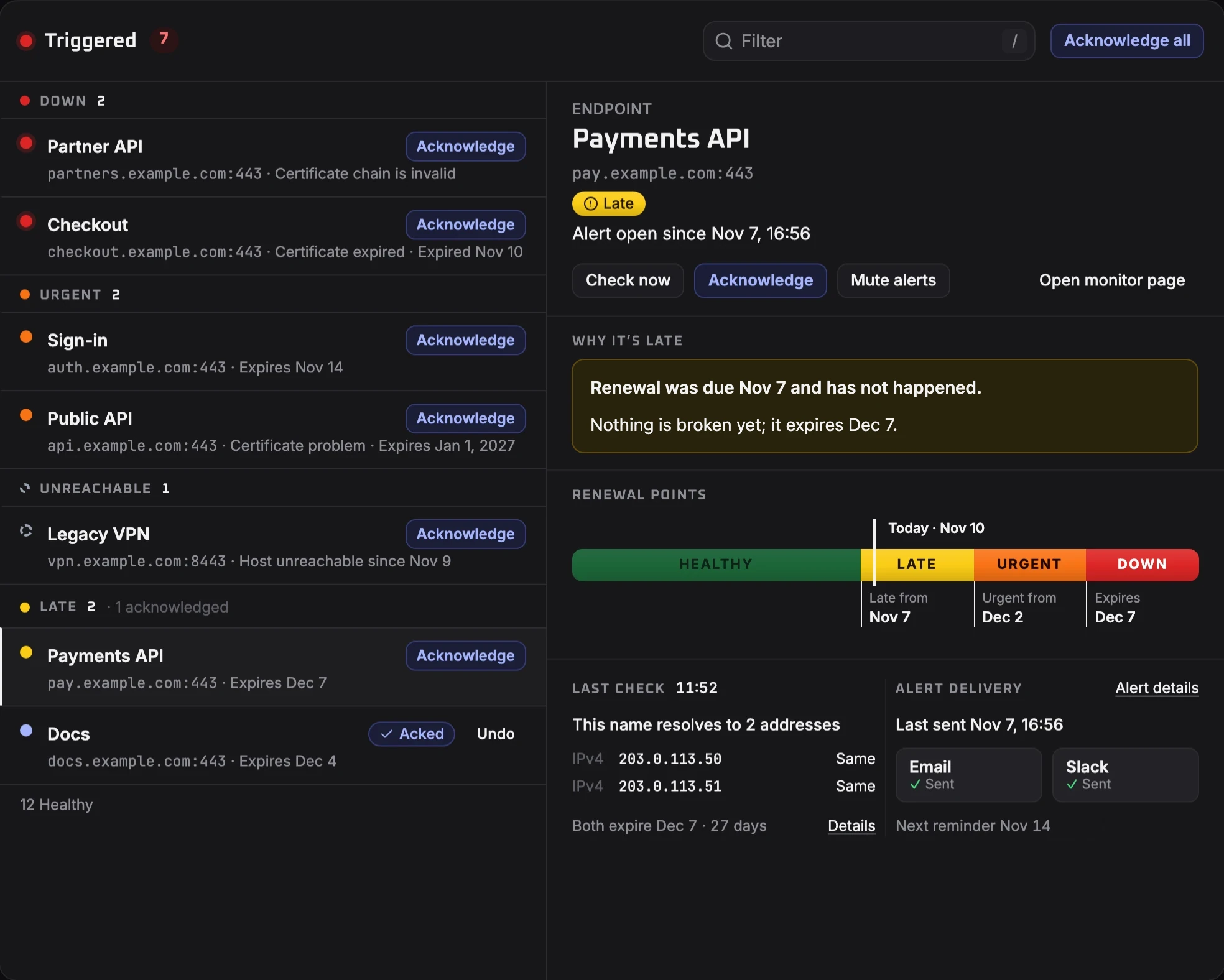
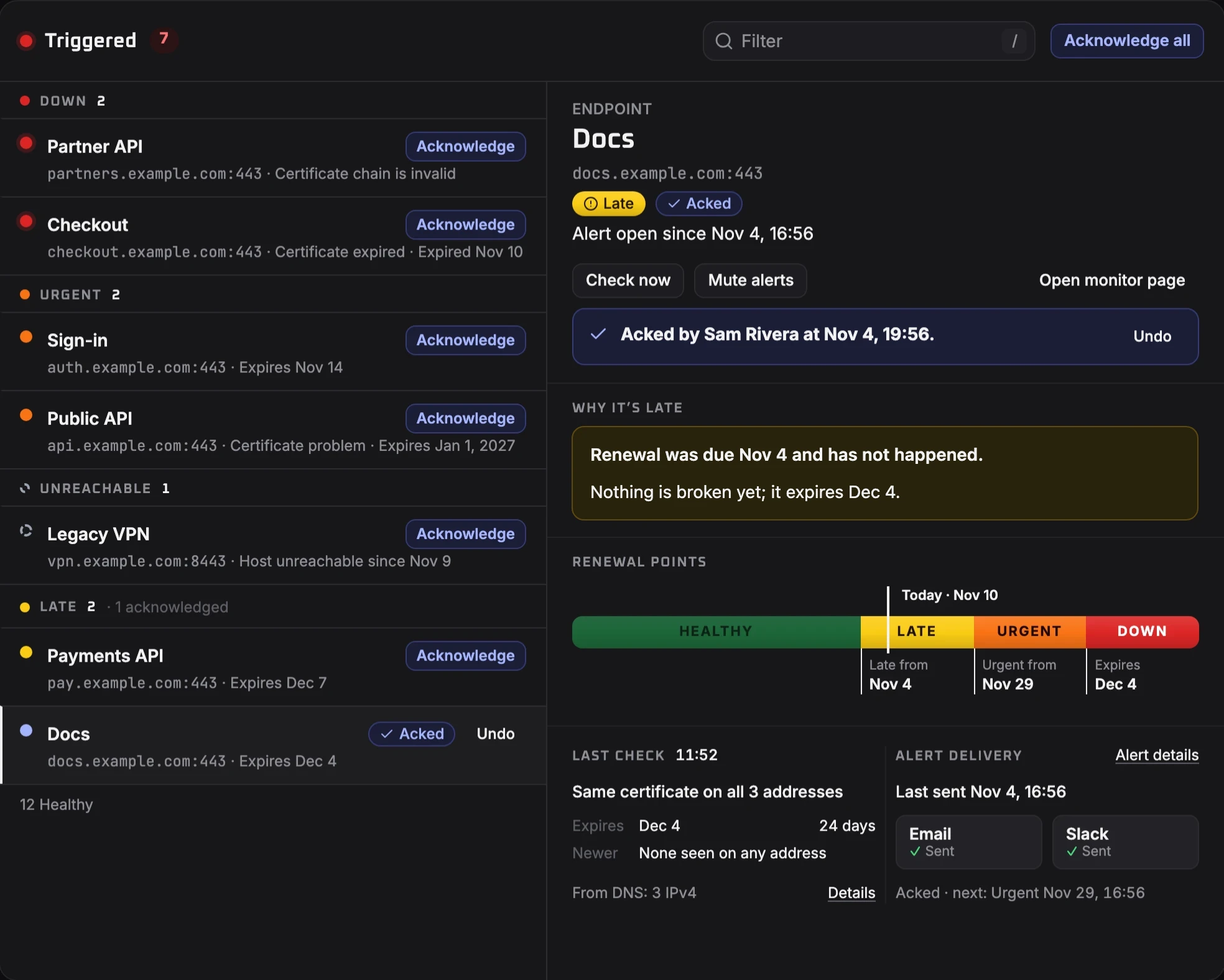
An expired certificate, a broken chain, a CA recall, a host that stopped answering, a late renewal. Each alert shows why it fired, the dates that matter and whether the message was delivered. Acknowledge one to hold its reminders.
Everything renewal monitoring needs.
A focused toolkit built for SSL/TLS certificate and domain renewal monitoring, not a repurposed general uptime monitor.
- Watched
- Renewals CertWatch has watched on your server.
- CA window
- Your CA's renewal window, once your client follows it.
- Setting
- A renewal setting you give it.
Late-renewal alerts
CertWatch works out when each certificate should renew. If that point passes with no new certificate on the server, you get a Late alert. A certificate renewed automatically on schedule is never Late.
Alert delivery you can check
Every alert records whether each channel accepted it. The dashboard flags a channel that is failing, and you can retry the messages it missed.
CA recall alerts
When a supported CA recalls a certificate by pulling its renewal window forward, as it does ahead of a revocation, CertWatch marks the certificate Urgent within hours and alerts you, even with weeks left.
- example.com
- Registered until 2027
- Transfer lock
- On
- DNSSEC
- Signed
- Registrant contact
- Not public
Domain registration expiry
CertWatch reads each domain's registration expiry daily and alerts once each at 30 days left (Late), 7 days left (Urgent) and on expiry (Down).
Check history
Every check is recorded, with issuer, chain validity and days remaining. Each new certificate is recorded as a certificate replacement, without an alert for a routine renewal.
Hourly checks on every plan, Free included. Every account starts on Free. No credit card required.
Starter
$12per month- 25 endpoints
- 5 domains
- 90-day history
- Email and Slack alerts
Pro
$29per month- 100 endpoints
- 25 domains
- 365-day history
- Email, Slack and webhook alerts
Why we built CertWatch
We built CertWatch after scrambling to renew a certificate we didn't know existed, while production was down and millions were at stake.
Questions
My uptime monitor already checks certificates. Why CertWatch?
An uptime monitor warns a set number of days before a certificate expires. CertWatch works out when each certificate should renew and alerts when that point passes with no new certificate on the server. It also alerts when a supported CA recalls a certificate.
Let's Encrypt stopped sending expiry emails. Does CertWatch replace them?
Yes, and it sees more. Those emails came from the CA's issuance records, not from your server, so they could not tell you that a renewed certificate never reached it. CertWatch checks the live server every hour and alerts you when a renewal is late, whether the job failed or the new certificate was never loaded.
What can't CertWatch monitor?
CertWatch connects from outside over a direct TLS connection, so a host on a private network is not covered.
What does Late mean?
A renewal should have happened by now and hasn't, but nothing is broken yet. CertWatch works out that point from your CA's renewal window, past renewals, or a setting you give it, so a certificate renewed automatically on schedule is never Late.
Do I need to install anything?
No. Give CertWatch a hostname and port, or a domain name. It connects from outside, the way a browser or API client does.
Does CertWatch monitor SSL certificates?
Yes. SSL is the older name for the protocol and TLS the current one; the certificates are the same. CertWatch reads the certificate a server presents over a direct TLS connection, on any port that accepts one.
Know when a renewal is late, while nothing is broken yet.
No credit card required.